European Commission’s Pea Estimates Undermine Confidence with Frequent Revisions
31 October, 2026
Admin
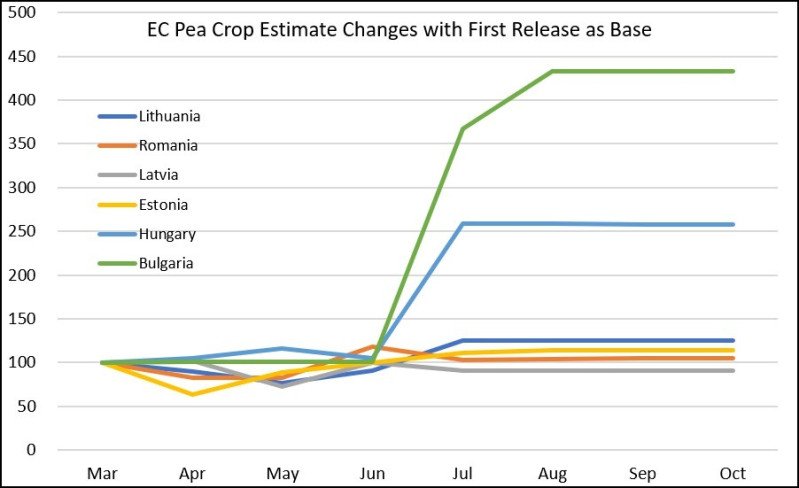
The European Commission’s 2026 pea production estimates have undergone repeated and sizeable revisions across the Baltics and Black Sea regions, raising questions about the reliability of its forecasting process for a single marketing year.
In the Baltics (Lithuania, Latvia and Estonia), combined estimates first fell by roughly one-fifth between March and May, only to rebound by more than 40% by July. Lithuania’s figures alone swung from an initial drop of about 23% to a subsequent recovery exceeding 60%. Estonia’s estimates moved within an 80% range, while Latvia’s numbers also shifted before stabilising.
The Black Sea group (Romania, Hungary and Bulgaria) showed persistent upward revisions. Aggregate estimates rose more than 40% from March to October. Hungary’s projection more than doubled, Bulgaria’s increased over fourfold, and Romania posted a mid-period gain of around 27%. Overall, the six countries’ combined estimate climbed roughly 22% across the period.
By contrast, AgPulse production estimates—derived from the firm’s proprietary yield model—remained unchanged from March through October for Lithuania, Estonia, Latvia and Romania. AgPulse subscribers across the European bloc can confirm this consistency.
Frequent swings in official estimates create practical difficulties for end users. Traders, exporters and buyers face shifting supply signals that complicate purchase planning, pricing decisions and logistics arrangements within a single marketing year. Stable reference numbers help reduce avoidable uncertainty in the market.
Discover in real-time how our product can transform operations, enhance decision-making, and drive growth. Book your free demo today to see the difference for your business!

Global Intelligence for Pulses, Grains & Oilseeds
Empowering informed decisions across the agricultural value chain with timely market insights, forecasting models, and trade analysis.
Follow Us