Pulses Inflation: Why Wholesale Pressures Are Outrunning Consumer Prices
03 November, 2026
Admin
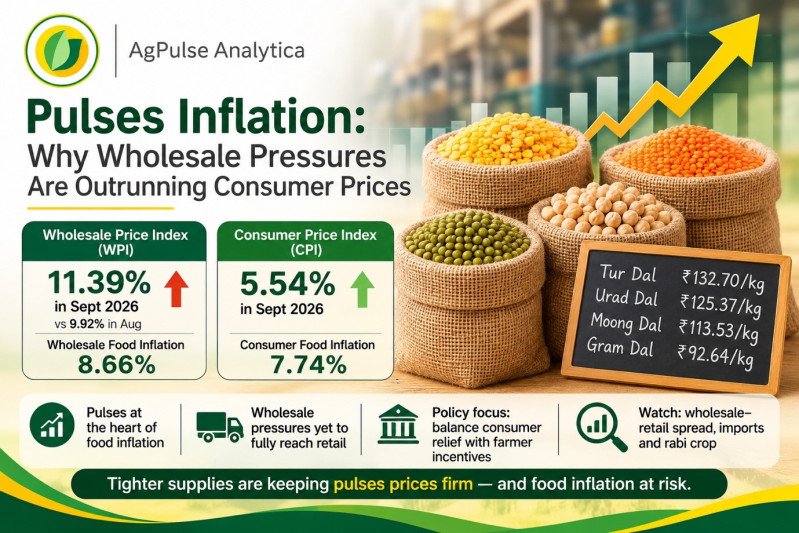
India’s September 2026 inflation numbers reveal a clear divergence. Wholesale price inflation (WPI) accelerated to 11.39% year-on-year from 9.92% in August, while wholesale food inflation stood at 8.66%. In contrast, consumer price inflation (CPI) remained more moderate at 5.54%, with consumer food inflation at 7.74%. The gap shows that price pressures are building more sharply upstream than they have yet fully appeared in household budgets.
Pulses sit at the centre of this dynamic. As a core protein staple, they carry significant weight in both the food basket and household expenditure. On 25 October, the Department of Consumer Affairs reported all-India average retail prices of ?132.70/kg for tur dal, ?125.37/kg for urad dal, ?113.53/kg for moong dal and ?92.64/kg for gram dal. These levels reflect sustained firmness after recent months of rising wholesale quotations driven by concerns over kharif output and delayed rabi sowing prospects.
The transmission from wholesale to retail is rarely instantaneous. Import costs, domestic crop arrivals, processing margins, transport expenses and retailer inventory levels all mediate the final price paid by consumers. As a result, elevated wholesale pulses prices can keep food inflation sticky even if other categories begin to ease. The current data suggest that wholesale markets are already pricing in tighter near-term availability, while retail inflation has only partially caught up.
This creates a dual challenge for policymakers. Containing household cost-of-living pressures is necessary, yet any intervention must avoid undermining incentives for domestic production. Buffer-stock releases, calibrated adjustments to import duties and improved availability of imported pulses remain the primary levers available, depending on how the rabi crop develops.
For pulses-market participants, the message is clearer than the raw inflation numbers alone suggest. The stronger rise in wholesale indices relative to CPI points to underlying supply tightness rather than a purely temporary spike. With monsoon shortfalls already behind us and rabi sowing still facing moisture constraints, current price levels are more likely to reflect a persistent tightening in availability than a short-lived seasonal move. Monitoring the evolution of wholesale–retail spreads, import volumes and government intervention will be critical in judging how long these elevated prices persist and how far they ultimately feed into broader food inflation.
Discover in real-time how our product can transform operations, enhance decision-making, and drive growth. Book your free demo today to see the difference for your business!

Global Intelligence for Pulses, Grains & Oilseeds
Empowering informed decisions across the agricultural value chain with timely market insights, forecasting models, and trade analysis.
Follow Us