Part 1: The Pulse Revolution: Mapping Kazakhstan’s Historic Lentil Boom
19 September, 2026
Admin
Introduction
For decades, global lentil trade maps were dominated by traditional powerhouses such as Canada and Australia. Over the past four years, however, a new agricultural force has rapidly reshaped the market.
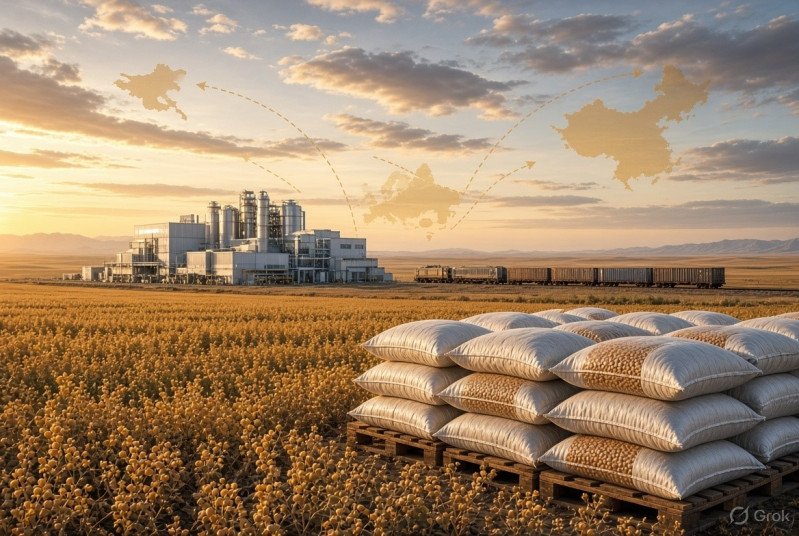
Kazakhstan, long known primarily for its vast wheat fields, has engineered an unprecedented boom in pulse production—particularly lentils. As a landlocked nation, this surge in crop volume has created a critical turning point: the country can no longer rely solely on exporting raw commodities. To sustain profitability and capture higher margins, Kazakhstan must evolve into a sophisticated processing and value-added agricultural hub.
A Look at the Numbers: The Multi-Year Export Surge
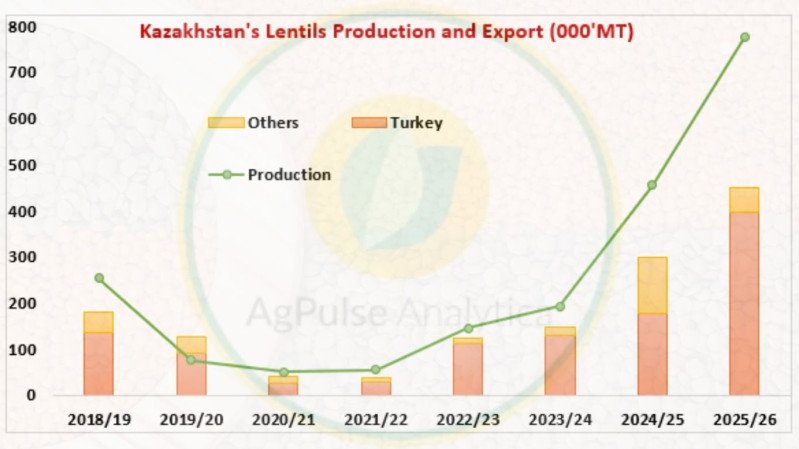
The speed of Kazakhstan’s rise is striking. Aggressive crop diversification has allowed farmers to pivot toward pulses and fundamentally alter the country’s export profile:
- 2021 baseline: Lentil exports stood at roughly 39,000–40,000 tonnes—still a minor presence on the global stage.
- 2024 (breakout year): Production reached approximately 456,000 tonnes (more than double the previous year). Lentil exports rose 47% to about 235,000 tonnes, placing Kazakhstan among the world’s top-six exporters.
- 2025–2026 (record levels): The 2025 harvest delivered an all-time high, with lentil output estimated 776,000 tonnes (within a total pulse harvest near 1 million tonnes). Exports in the 2025/26 marketing year are tracking toward a projected record of around 440,000–470,000 tonnes. By 2025 Kazakhstan had entered the global top five, competing directly with Canada, Australia, the United States and Russia.
Turkey remains by far the dominant buyer, consistently accounting for the large majority of shipments (often 80–94%). Secondary destinations include Italy, the UAE and Afghanistan, with smaller volumes moving to other markets.
The Logistical Wall
While the production numbers are impressive, moving large volumes of raw legumes out of Central Asia presents persistent challenges. Complete reliance on cross-border rail and trucking corridors, combined with historically inconsistent grading and mixed sizes, meant Kazakh farmers often sold raw lentils at a discount to Turkish processors. Those goods were processed abroad and re-exported at a premium.
Rising freight costs and landlocked bottlenecks have made the strategic reality clear: to keep farming profitable, Kazakhstan must process more of its crop at home.
In Part 2 we examine the wave of infrastructure investment—Turkish pulse specialists, Chinese corporations and domestic firms—that is building this new processing capacity.
Discover in real-time how our product can transform operations, enhance decision-making, and drive growth. Book your free demo today to see the difference for your business!

Global Intelligence for Pulses, Grains & Oilseeds
Empowering informed decisions across the agricultural value chain with timely market insights, forecasting models, and trade analysis.
Follow Us