Pulses Inflation: Can India Ease Household Food Costs Without Undermining Farmers?
24 October, 2026
Admin
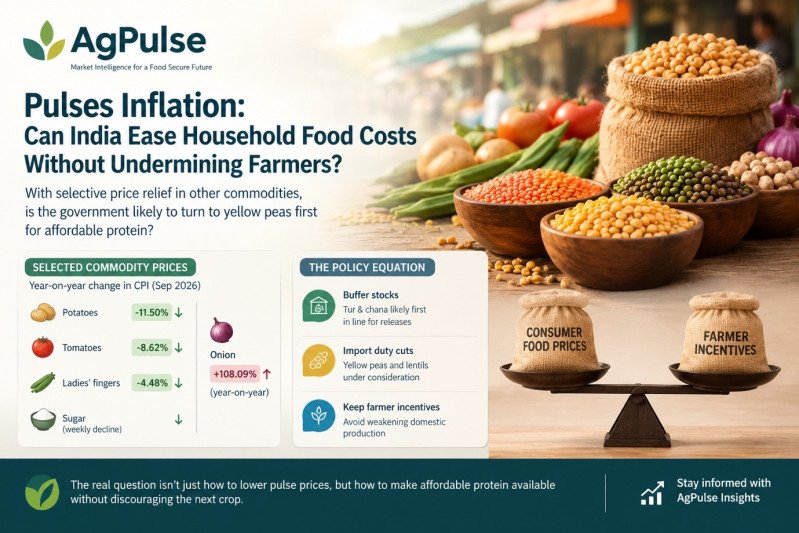
India’s food-inflation challenge is becoming a balancing act: reduce the cost of household essentials without weakening incentives for domestic production.
There is some room for relief outside pulses. In September 2026, official consumer-price data showed year-on-year declines in potatoes (11.50%), tomatoes (8.62%) and ladies’ fingers (4.48%). But these declines coexist with sharp inflation in other essentials, including onions, whose prices rose 108.09% year-on-year. Falling prices in selected vegetables may therefore provide only partial relief to household budgets.
For policymakers, the question is whether broader food inflation can be moderated through better availability and targeted interventions in other commodities, allowing pulse prices to reflect domestic farmers’ production costs and market incentives. That approach has limits: if pulses remain a major source of food-price pressure, avoiding intervention altogether may not be practical.
*If the government does intervene in pulses, which commodity is most likely to come first?*
For immediate consumer relief, tur and chana are key candidates. Recent reporting indicates that both are attracting requests for government-buffer supplies, while retail prices of tur and urad remain elevated. But direct stock releases must be calibrated so that consumer relief does not unnecessarily weaken farm-gate prices.
A second route is to increase the availability of substitutes. Yellow peas, used in pulse-based foods and besan, can help relieve demand pressure on chana. Easing import duties on yellow peas or lentils could therefore be an alternative to forcing down domestic prices. Reuters reported that India was considering such duty cuts while potentially retaining protection for chickpeas to encourage domestic planting.
The policy choice is not simply whether to lower pulse prices, but *how to make affordable protein available without discouraging the next crop*. Whether substitution, imports or buffer-stock releases offer the least disruptive solution will depend on price trends, stocks and the outlook for domestic production.
Discover in real-time how our product can transform operations, enhance decision-making, and drive growth. Book your free demo today to see the difference for your business!

Global Intelligence for Pulses, Grains & Oilseeds
Empowering informed decisions across the agricultural value chain with timely market insights, forecasting models, and trade analysis.
Follow Us