Part 2: Concrete and Infrastructure: Who Is Building Kazakhstan’s New Processing Matrix?
26 September, 2026
Admin
Related article:
Part 1: The Pulse Revolution: Mapping Kazakhstan’s Historic Lentil Boom
Part 3: Rewriting Global Trade: The Strategic Conclusion of Kazakhstan Pulse Shift
Introduction
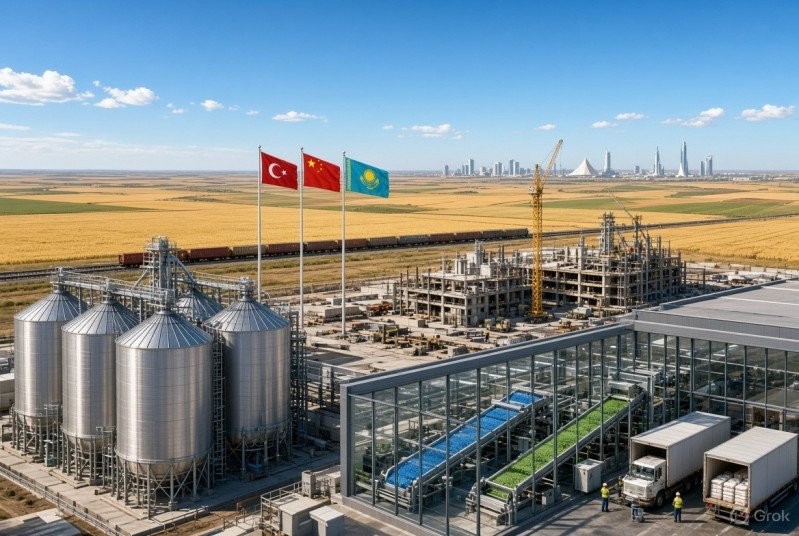
Record lentil volumes have triggered an industrial building boom. To reduce logistics costs and capture higher margins, a mix of international agribusinesses and local companies are establishing advanced cleaning, sorting and deep-processing facilities inside Kazakhstan.
The Turkish Influx: High-Volume Pulse Hubs
Turkish pulse companies, long known for their re-export operations in Mersin, were among the first to relocate processing capacity closer to the source:
Agro / Kazak Protein: In partnership with Kazakh firms including ADOtex, Tiryaki is developing a $320 million integrated agro-industrial complex in Astana. The facility will process 250,000 tonnes of wheat and 80,000 tonnes of pulses (peas and lentils) annually, using deep-processing technology to produce plant-protein isolates, starches and related high-value products. Construction is underway with phased completion targeted for 2027–2028.
- Arbel (Kaizen LLP): In the Kostanai region, Arbel established a modern legume-processing plant with roughly 170,000 tonnes of annual capacity for peas, red and green lentils, chickpeas and related crops. Equipped with advanced optical sorting (including Sortex technology), the facility produces high-purity product that meets European food standards and is already exporting.
- Armada Foods (Armada G?da): One of Turkey’s major pulse processors, Armada has established a local subsidiary (AC Agro LLP, founded 2022) and is advancing plans for a dedicated pulses processing facility in Kazakhstan. The company has already developed storage capacity (including sites in the Kostanai and Petropavlovsk areas) and secured a $110 million international syndicated loan (led by FMO) in 2026 that explicitly funds, among other projects, a new light-processing pulses plant in the country. Earlier discussions had targeted northern Kazakhstan with capacities potentially reaching 100,000 tonnes of finished product; the latest financing confirms the project as a core part of Armada’s regional expansion strategy.
Chinese Investments: Broader Processing Infrastructure
Chinese corporations are financing large multi-phase projects that form part of Kazakhstan’s wider agricultural processing push, even if many focus primarily on grain rather than pulses:
- **Wanlin Group**: A project originally valued at $30 million (later scaled higher) in the Zhambyl/Turkistan area centres on dehydrated vegetable production, illustrating Chinese interest in value-added agri-processing.
- **CITIC Construction**: Plans for a major deep-grain processing facility in the Almaty region involve investments exceeding $1 billion and capacities in the hundreds of thousands to around 1 million tonnes of wheat annually, producing starches, syrups, gluten and feed.
- **Dalian Hesheng Holdings**: A multi-phase project in the Akmola region (investments ranging from several hundred million to over $1 billion) aims ultimately at multi-million-tonne wheat deep-processing capacity, including amino acids and related products.
These grain-focused projects expand overall processing infrastructure, logistics capacity and technical expertise that support the pulse sector’s development.
Domestic Firms Pivot to Value Addition
Kazakh agri-holdings, backed by sovereign financing channels including Baiterek National Management Holding, are also investing in specialised facilities:
- Agroleader KAZ: Operates a modernised legume and oilseed facility with significant annual capacity, producing and packaging multiple finished pulse products for export. Optical sorting and quality control systems enable direct supply to international buyers.
- Qazaq Food Market (QFM): Based in the northern logistics hub of Kokshetau, QFM uses advanced optical sorters to prepare uniform, high-purity retail-ready lentils for global distributors.
- Grain Partners LLP: Focuses on high-purity cleaning lines (targeting 99.5%+ food-grade standards) and packaging for premium lentils destined for European and other markets via containerised rail.
- ADOtex LLP: Partners with Tiryaki in the Kazak Protein joint venture, contributing to the $320 million Astana deep-processing hub.
In the final part we examine how these facilities are beginning to rewrite trade routes and the state policies designed to make the shift permanent.
Discover in real-time how our product can transform operations, enhance decision-making, and drive growth. Book your free demo today to see the difference for your business!

Global Intelligence for Pulses, Grains & Oilseeds
Empowering informed decisions across the agricultural value chain with timely market insights, forecasting models, and trade analysis.
Follow Us