Last Part: Global Dry Pea Trade - Canada and Russia Compete for Export Dominance
24 July, 2026
Admin
Related article:
Part 1: From Drought to Recovery - Canadian Dry Pea Production Trends MY 2021-22 to MY 2025-26
Part 2: Russia Emerges as a Global Pea Powerhouse - Production and Acreage Trends
Part 3: China Expanding Dry Pea Market Fuels Competition Between Russia and Canada
Part 4: India Dry Pea Import Market - Policy Shifts, Trade and the Canada-Russia Competition
Dry peas have become one of the world's most strategically traded pulse crops, with international trade playing a far greater role than domestic consumption in determining market direction. Unlike many agricultural commodities that are primarily consumed where they are produced, dry peas depend heavily on export demand. Global consumption is concentrated in major importing countries such as India, China, Bangladesh, Pakistan, Turkey, and several Middle Eastern nations, while Canada and Russia dominate export supplies. As a result, changes in production, trade policy, or logistics in these countries can quickly influence global prices and trade flows.
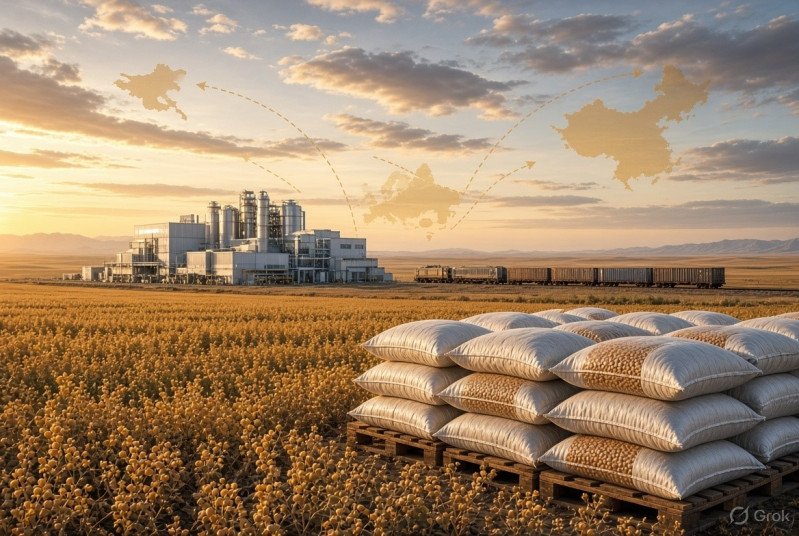
The international pea market has undergone a significant transformation over the past decade. Canada has long been the world's leading exporter, supported by high-quality production, reliable supplies, and an efficient grain handling and transportation system. However, Russia has rapidly emerged as a formidable competitor by expanding planted acreage, improving crop yields, investing heavily in rail and port infrastructure, and offering competitively priced exports. At the same time, shifting import policies in major consuming countries, particularly India, have reshaped global trade patterns and intensified competition between the two exporting giants.
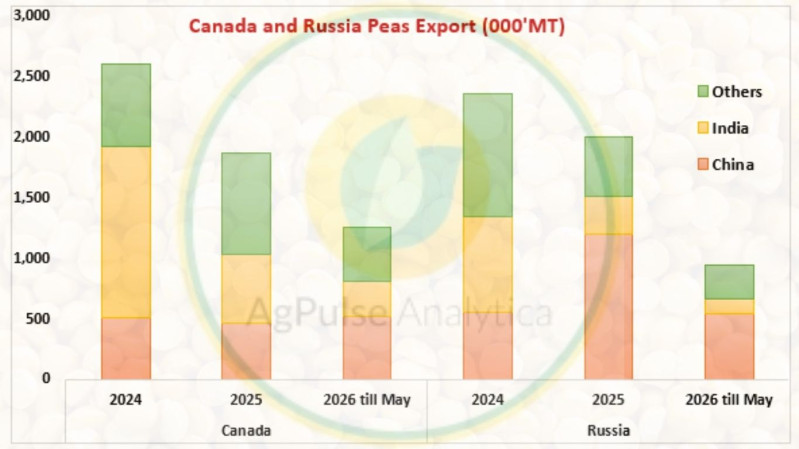
Canada continues to rank among the world's largest producers and exporters of dry peas. Saskatchewan accounts for nearly half of national production, while Alberta and Manitoba are also major producing regions. Historically, India and China have been Canada's largest export destinations. When India imposed import restrictions between 2017 and 2023, Canadian exporters successfully diversified shipments to China, Bangladesh, and several other Asian markets. Following India's decision to permit duty-free pea imports in late 2023, exports to South Asia rebounded sharply. Statistics Canada reported that Canadian pea exports reached nearly 1.3 million metric tonnes during January-April 2026, well above shipments during the corresponding period a year earlier. India became Canada's largest buyer during 2024 and 2025, while exports to China also strengthened as bilateral trade conditions improved in 2026.
Russia has established itself as the fastest-growing supplier in the global pea trade. Production has expanded across major agricultural regions, including Siberia, the Volga, Central, Southern, North Caucasian, and Ural Federal Districts. Supported by improved logistics and favourable trade agreements, Russia has steadily increased exports to China, India, Turkey, Bangladesh, Pakistan, and Middle Eastern markets. Its competitive pricing, lower production costs, and shorter shipping distances to Asia have strengthened its position, although Canadian peas continue to command premium prices due to superior quality and consistency.
Looking ahead, global pea demand is expected to expand steadily as plant-based protein consumption and food processing industries continue to grow. While Canada is likely to retain its reputation as the premium supplier, Russia is expected to capture additional market share through competitive pricing and expanding export capacity. Consequently, future global pea trade will be shaped not only by crop production but also by government policies, logistics, infrastructure investments, and geopolitical developments.
Contact or subscribe to AgPulse Analytica for detailed information, along with deeper market insights and detailed analysis for informed decision-making.
Discover in real-time how our product can transform operations, enhance decision-making, and drive growth. Book your free demo today to see the difference for your business!

Global Intelligence for Pulses, Grains & Oilseeds
Empowering informed decisions across the agricultural value chain with timely market insights, forecasting models, and trade analysis.
Follow Us