Part 4: India Dry Pea Import Market - Policy Shifts, Trade and the Canada-Russia Competition
18 July, 2026
Admin
Related article:
Part 1: From Drought to Recovery - Canadian Dry Pea Production Trends MY 2021-22 to MY 2025-26
Part 2: Russia Emerges as a Global Pea Powerhouse - Production and Acreage Trends
Part 3: China Expanding Dry Pea Market Fuels Competition Between Russia and Canada
Last Part: Global Dry Pea Trade - Canada and Russia Compete for Export Dominance
India remains one of the world's largest importers of dry peas, with imports playing a vital role in supplementing domestic supplies and maintaining price stability in the pulse market. Yellow peas are widely used as a substitute for desi chickpeas and serve as an important raw material for the food processing industry, particularly in the production of besan, snack foods, and other value-added products.
Changes in India's import policy have a significant impact on global dry pea trade.
To address supply concerns and contain food inflation, the Government of India permitted duty-free imports of dry peas in December 2023. The measure has been extended several times, with the latest notification allowing duty-free imports through March 2027. The policy has encouraged a substantial increase in imports while helping moderate domestic pulse prices.
Import Policy Timeline
· Before December 2023: Regular import tariff
· December 2023 – October 2025: Duty-free imports
· November 2025: 30% import duty imposed
· April 2026 – March 2027: Duty-free imports reinstated
Although the temporary 30% duty introduced in November 2025 aimed to protect domestic farmers during the harvest season, it was subsequently withdrawn as the government prioritized adequate supplies and price stability.
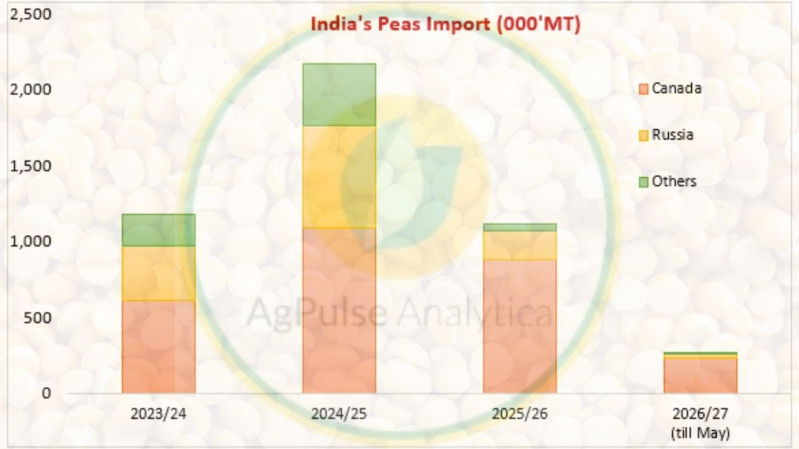
The reopening of the market resulted in a sharp recovery in import volumes during 2024 and 2025. Canada's exports to India rebounded strongly, supported by its reputation for consistent quality and long-standing commercial relationships with Indian buyers. At the same time, Russia expanded its presence by offering competitively priced peas and increasing export availability. India's dry pea imports reached 2.95 million metric tonnes in 2024, making the country one of the largest destinations for global exporters.
Price competitiveness continues to be the primary factor determining market share. Russian dry peas generally trade at a discount to Canadian origin because of lower production and logistics costs, making them attractive to price-sensitive importers. Canadian peas, however, continue to enjoy steady demand due to their superior quality, higher protein content, and dependable supply chain, particularly among processors requiring consistent raw material specifications.
Looking ahead, India's import demand will be shaped by domestic pulse production, government trade policy, and the relative pricing of Canadian and Russian peas. With duty-free imports scheduled to remain in effect until March 2027, both origins are expected to play a significant role in supplying the Indian market. Nevertheless, Russia is likely to retain a competitive pricing advantage, while Canada is expected to maintain a strong presence in premium quality segments.
Contact or subscribe to AgPulse Analytica for detailed information, along with deeper market insights and detailed analysis for informed decision-making.
Discover in real-time how our product can transform operations, enhance decision-making, and drive growth. Book your free demo today to see the difference for your business!

Global Intelligence for Pulses, Grains & Oilseeds
Empowering informed decisions across the agricultural value chain with timely market insights, forecasting models, and trade analysis.
Follow Us