Russia Pea Logistics Under Pressure: Could China Turn Back to Canada?
23 August, 2026
Admin
Russia’s rise in China’s dry pea market has been one of the most significant changes in global pulse trade. In the 2023/24 marketing year, Russia exported approx. 1.13 MMT of peas to China, capturing 49.1% of the Chinese import market, while Canada’s share fell to 44.6%.
We explored this shift in detail in our earlier article, “China’s Expanding Dry Pea Market Fuels Competition Between Russia and Canada”. But Russia’s pea story is now facing a new challenge — logistics.
Russia’s export routes come under pressure
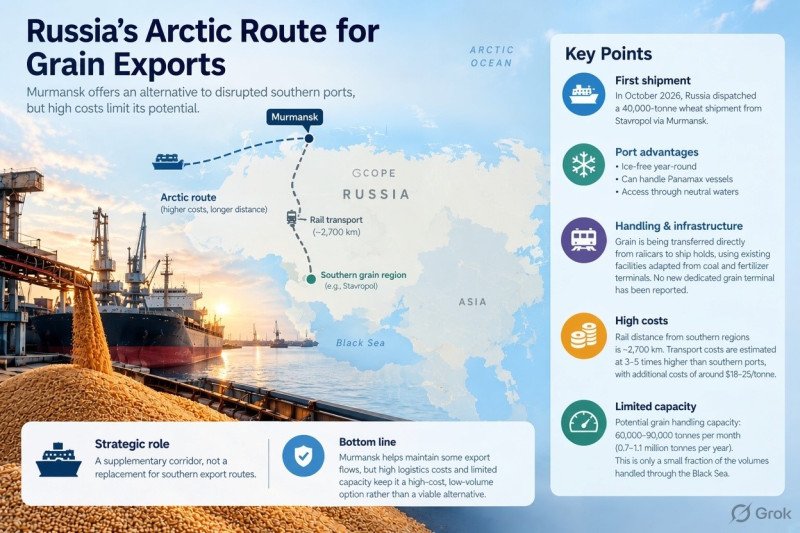
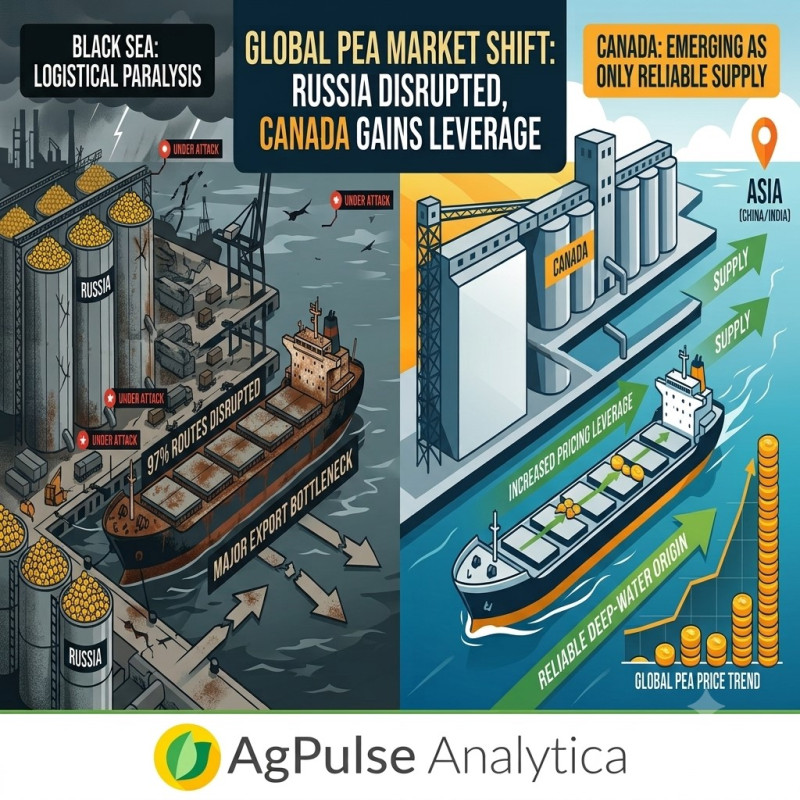
Since July, attacks have severely disrupted Russia’s Black Sea and Azov export infrastructure. The Azov ports alone account for nearly 25% of Russia’s grain exports, while Black Sea ports account for more than 50%. Following the August 12 strike on Novorossiysk, three major grain terminals — KSK, NZT and NKHP — suspended operations. Their combined annual capacity is estimated at 26.1 MMT.
For peas, this creates a significant logistical problem. Russia can move cargo through rail and alternative ports, but replacing southern seaborne routes with rail is neither instantaneous nor cost-neutral.
The vulnerability is particularly important because Russia had already built a large pea surplus. Its 2025/26 pea harvest was estimated at 5.52 MMT, up approximately 44% year-on-year, while analysts estimated a surplus of around 800 KMT after exports to China failed to meet expectations.
Canada suddenly looks more important
Canada may be better positioned to capture some of the displaced Chinese demand, but its supply cushion is considerably smaller.
According to Agriculture and Agri-Food Canada, Canadian dry pea production for 2026/27 is forecast at 3.15 MMT, down from 3.93 MMT in 2025/26. Exports are projected at 2.70 MMT, leaving only 860 KMT of carry-out stocks and a 26% stocks-to-use ratio.
This creates an interesting contrast: Russia has the peas but increasingly faces difficulty moving them, while Canada has reliable seaborne logistics but a much smaller crop.
If Chinese processors need to replace even a portion of Russian supply, Canadian prices could come under upward pressure.
The next key indicators for the pea market will therefore be Russian port loadings, Russia–China rail flows, Russian FOB offers and the landed-price spread between Russian and Canadian peas in China.
The market may be moving from a question of “How many peas does Russia have?” to a more important one:
“How many Russian peas can actually reach China?”
Discover in real-time how our product can transform operations, enhance decision-making, and drive growth. Book your free demo today to see the difference for your business!

Global Intelligence for Pulses, Grains & Oilseeds
Empowering informed decisions across the agricultural value chain with timely market insights, forecasting models, and trade analysis.
Follow Us